A robot can learn a task from human movement instead of receiving every motion as hand-written code. The method sounds simple, but the robot still has to connect what it sees with objects, forces, timing, and safe action.
- A camera records human motion, but the robot must map that motion to its own joints.
- Imitation learning turns examples into a policy, which is a rule for choosing the next action.
- Good demonstrations help, but unusual objects and small errors can still stop the task.
From human motion to robot action
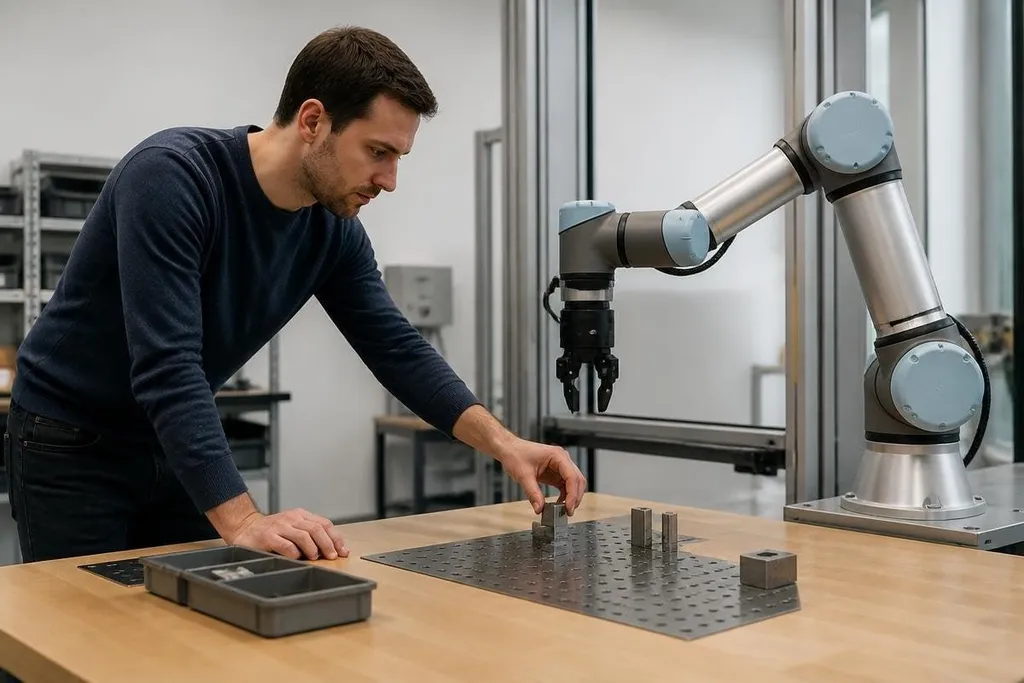
The process starts with a demonstration. A person may move an arm, pick up a part, or guide a gripper through a task. Cameras, joint sensors, or force sensors record what happened over time.
That recording is not yet a robot program. Human arms and robot arms have different shapes, joint limits, speeds, and control systems. The robot must map the observed movement into actions its own hardware can perform.
A robot may first track points such as the hand, wrist, or elbow. It can also track the object being moved. The software then links those points to robot commands, such as moving an end effector, which is the tool at the end of the arm.
The link between seeing and acting matters because a robot rarely repeats a motion in empty space. It must know where the object is, how close the gripper is, and when contact has happened.
What imitation learning does
Imitation learning uses examples of a person doing a task to build a policy. The policy takes information from sensors and selects an action, such as moving left, closing the gripper, or slowing down near an object.
A common method records many human actions and trains a model to connect each scene with the next useful move.
During a later run, the robot compares its sensor input with patterns from those examples and chooses an action.
This approach can cut the amount of hand-written control code needed for tasks with many small movements. It also gives engineers a way to teach behavior that would be difficult to describe with fixed rules, such as how a hand adjusts its path around an object.
Beneath the learned policy, a control layer checks speed, joint limits, collisions, and force. A learned model can suggest an action, but the control system decides whether the hardware can carry it out safely.
Why demonstrations fail
A demonstration shows one path through a task. It may not show what to do when the part has moved, the lighting changes, or the gripper meets more resistance than expected.
This creates a problem called distribution shift. A later run may present a situation that differs from the examples used during training, so its next action may be poor. Small changes can matter when the task depends on contact, such as inserting a plug or placing a part into a tight fixture.
Human demonstrations also contain pauses, extra movements, and mistakes. The training process has to separate useful action from movement that happened by chance. A person may recover from an error without thinking about it, but the robot needs a rule for that recovery.
Force sensing can help with contact tasks. Vision can show where an object is, while force data can show whether the gripper has touched it or pushed too hard. The machine needs enough information for the task, and more sensors also mean more data to manage.
A human demonstration can teach a motion, but it doesn't prove the robot can repeat that motion when the object, surface, or timing changes. Robot24.com reports on robot learning can connect each method to a named machine, task, and test result before the next section looks at where it fits.
Where the method fits
Watching a person works best when the task has a clear goal and the robot can repeat the same type of motion. Assembly steps, object sorting, lab work, and remote operation can all use demonstrations when the scene stays within known limits.
A human can also guide a robot through teleoperation. In that setup, the operator controls the robot from a distance, and the recorded actions can become training data for later runs. The robot may then handle familiar parts of the task without constant human input.
The method is a poor fit when each object needs a different plan or when a mistake can damage equipment. A training set made from one tool, one part, or one work surface may not cover the changes found on a production line.
I’d trust watching-based learning for repeatable tasks with a clear safety check, but I wouldn’t remove a skilled operator until the robot has been tested on the failures that matter.
A practical check before deployment
Use this guide before treating demonstrations as a working robot skill:
- Define the task: write down the start state, goal, allowed contact, and stop condition.
- Record the scene: include the object, tool, workspace, and sensor data that the robot will receive later.
- Vary the examples: change object position, lighting, speed, and small human errors when the task allows it.
- Test recovery: add cases where the object slips, moves, or arrives in the wrong position.
- Keep a safety layer: limit speed, force, and joint movement outside the learned policy.
- Set a human handoff: decide when an operator must take control and record that event.
The next step for this field is not teaching robots to copy every human motion. It is teaching them which parts of a demonstration matter, then checking those learned actions against real objects, real contact, and real failure cases.